GE Refrigerator Not Cooling: Expert Troubleshooting Guide
GE refrigerators — including the GE Profile, GE Cafe, and standard GE lines — are installed in millions of American homes. When your GE fridge stops cooling, the clock starts ticking on your perishable food. This guide covers every common cause of cooling failure across GE's lineup, from the straightforward GE GTS18GTHWW top-freezer to the premium GE Profile PVD28BYNFS French Door and GE Cafe CVE28DP side-by-side models.
How GE Refrigerators Regulate Temperature
GE uses a variable-speed compressor system on newer models (branded as "Turbo Cool" on Profile models) and a traditional single-speed compressor on standard models. Both systems rely on the same core components: a compressor, condenser coils, evaporator coils, expansion valve, and air circulation fans.
GE's newer models (2018+) use the GE Appliances Wi-Fi Connect platform, which allows remote diagnostics and temperature monitoring through the SmartHQ app. If you have a connected model, check the app first — it may display a specific error code or alert.
1. Condenser Coils Covered in Dust
GE places the condenser coils at the bottom of the unit behind the base grille on most models. These coils are responsible for dissipating heat from the refrigeration system. When coated with dust and debris, the compressor overworks and eventually cannot maintain proper temperatures.
Symptoms:
- Refrigerator gradually loses cooling over days or weeks
- Compressor runs constantly
- Back or bottom of unit is hot to the touch
How to fix:
- Unplug the refrigerator.
- Remove the base grille (usually snaps off or has two screws).
- Use a coil brush and vacuum to clean the condenser coils thoroughly.
- Clean the condenser fan blade if accessible (mounted next to the coils).
- Replace the grille and restore power.
Maintenance: Clean condenser coils every 6–12 months. This single step prevents the majority of gradual cooling failures.
2. Condenser Fan Motor Failure
The condenser fan draws air across the condenser coils and also cools the compressor. If it fails, both the compressor and coils overheat.
Symptoms:
- You don't hear a fan running near the compressor (at the back, near the bottom)
- The compressor area is extremely hot
- The refrigerator runs but doesn't cool either compartment
How to diagnose:
- Unplug the unit and remove the rear access panel at the bottom.
- Spin the condenser fan by hand. It should rotate freely. If it's stiff, the motor bearings are worn.
- Check for debris (wire, plastic, food wrapping) tangled around the blade.
- If the fan is clear but doesn't run when powered, the motor is failed.
GE condenser fan motor part numbers:
- WR60X10220 (standard models)
- WR60X26866 (Profile/Cafe models)
Cost: $25–$60 for the motor. Professional repair runs $150–$250.
3. Evaporator Fan Motor Failure
The evaporator fan circulates cold air from the freezer into the refrigerator compartment. On GE models, this fan is located behind the rear panel inside the freezer.
Symptoms:
- Freezer stays cold but the fresh food section is warm
- No air movement from the refrigerator vents
- A humming or clicking noise from inside the freezer
How to diagnose:
- Open the freezer door. On most GE models, the evaporator fan stops when you open the door (safety feature).
- Press and hold the door switch to simulate a closed door. Listen for the fan.
- If the fan doesn't run, access it by removing the rear freezer panel (4–6 screws) and test the motor.
Part numbers:
- WR60X10185 (top-freezer models)
- WR60X10209 (French Door/side-by-side models)
Cost: $20–$50 for the motor. Professional repair runs $150–$250 total.
4. Defrost System Failure
GE refrigerators use an automatic defrost system that activates every 8–12 hours to melt frost from the evaporator coils. If any defrost component fails, ice accumulates on the coils and blocks airflow.
Symptoms:
- Ice or frost visible on the back wall of the freezer (behind the panel)
- Cooling gradually worsens over 1–2 weeks, then recovers after manual defrost, then worsens again
- Water on the freezer floor
Defrost components to check:
- Defrost heater (WR51X10055 for most GE models): A glass tube heater that runs along the evaporator. Test for continuity — it should read 20–50 ohms. Open circuit = failed.
- Defrost thermostat/bi-metal (WR50X10068): Located on the evaporator, it closes to allow current to the heater when the coil temperature drops below approximately 15°F. Should show continuity when cold.
- Defrost timer or defrost control board (WR55X10942 for timer; WR55X10942P for electronic board): The timer advances the system into defrost mode. If it fails, defrost never initiates. GE has transitioned from mechanical timers to electronic adaptive defrost boards on newer models.
Quick test for defrost issue:
- Unplug the refrigerator for 24 hours with the doors open to fully defrost.
- Plug it back in. If cooling returns to normal and then gradually worsens over 1–2 weeks, the defrost system is the problem.
5. Damper Control Problem
The air damper between the freezer and refrigerator controls how much cold air flows into the fresh food section. GE uses both mechanically operated dampers (controlled by a thermostat knob) and electronically controlled dampers (on Profile and Cafe models).
Symptoms:
- Freezer is at the correct temperature but the refrigerator section is warm
- Adjusting the refrigerator temperature setting makes no difference
How to check:
- Locate the damper — usually at the top-rear of the fresh food compartment.
- Listen for the damper motor operating when you change the temperature setting (electronic models).
- On mechanical models, remove the damper cover and check that the baffle moves when you turn the temperature control.
Cost: Electronic damper assemblies run $40–$80. Professional repair is $180–$280.
6. Start Relay or Compressor Issue
The start relay helps the compressor motor start. When it fails, the compressor can't start and the refrigerator gets no cooling at all.
Symptoms:
- No cooling in either compartment
- Clicking sound every 2–5 minutes from the rear of the unit (the compressor tries to start, fails, and the overload protector trips)
- Complete silence from the back of the unit
How to diagnose:
- Unplug the refrigerator.
- Pull it away from the wall and remove the rear access panel.
- The start relay is a small component plugged into the compressor's terminal pins.
- Remove the relay and shake it. A rattling sound indicates a broken internal contact.
- Test with a multimeter between the start and run terminals — should show 3–12 ohms.
Common GE start relay: WR07X10097 ($15–$35)
If the start relay is fine but the compressor still won't run, the compressor itself may have failed. GE compressors carry a 5-year limited warranty (parts only on some models). Full compressor replacement costs $400–$800.
7. Temperature Control Thermostat
The temperature control thermostat directs voltage to the compressor and fan motors based on the temperature setting. If it fails, these components won't receive power.
How to test:
- Rotate the thermostat from lowest to highest setting. You should hear a click as it engages.
- If no click, disconnect power and test the thermostat for continuity at the coldest setting. No continuity = failed thermostat.
Part numbers: WR09X10042 (many GE models), approximately $30–$50.
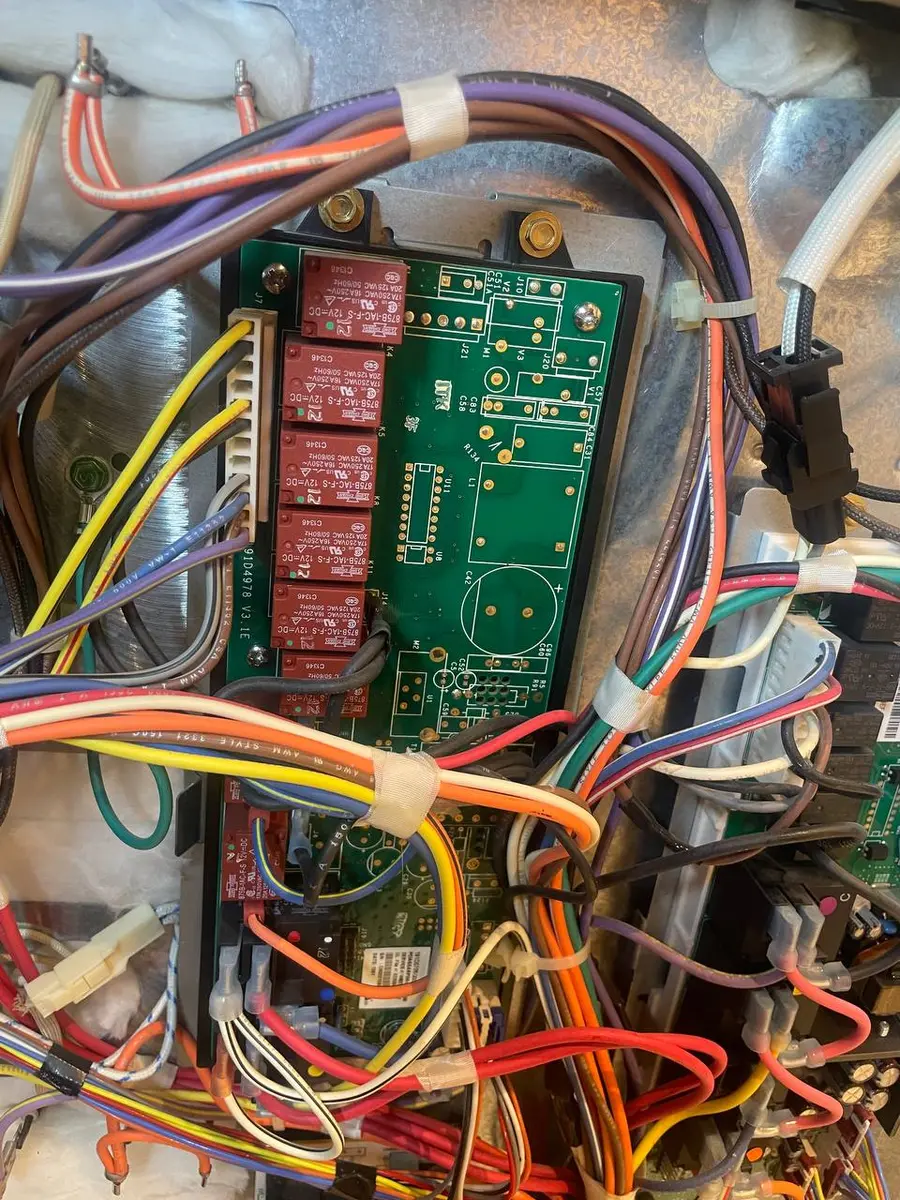
8. Main Control Board
On electronic GE models (Profile, Cafe, and newer standard models), the main control board manages all refrigerator functions. Power surges, age, and moisture can cause board failure.
Symptoms:
- Multiple functions fail simultaneously
- Error codes on the display or in the SmartHQ app
- Unit behaves erratically
Common GE control boards:
- WR55X10942P (top-freezer electronic defrost board)
- WR55X26733 (French Door main board)
- WR55X30490 (GE Profile/Cafe main board)
Cost: $100–$350 for the board, $200–$500 total with professional installation.
GE Refrigerator Diagnostic Mode
For GE Profile and Cafe models with a display:
- Press and hold the Fresh Food and Freezer temperature UP buttons simultaneously for 5 seconds.
- The display enters diagnostic mode showing error codes and sensor readings.
- Press the door alarm pad to cycle through stored error codes.
For standard GE models:
- These don't have a formal diagnostic mode. Diagnosis is done by testing individual components with a multimeter.
SmartHQ App (Wi-Fi models):
- Open the GE SmartHQ app and select your refrigerator.
- Navigate to the support/diagnostic section.
- The app can run remote diagnostics and display error codes with recommended actions.
Temperature Recovery Tips
While troubleshooting or waiting for repair:
- Keep doors closed as much as possible. A closed refrigerator maintains safe food temperatures for approximately 4 hours. A full freezer stays safe for 48 hours (24 hours if half full).
- Place bags of ice in the fresh food section as a temporary measure.
- Move highly perishable items (dairy, raw meat) to a cooler with ice.
- Use a refrigerator thermometer to monitor actual temperatures. Food is unsafe above 40°F for more than 2 hours.
Frequently Asked Questions
Q: Why is my GE refrigerator running but not cooling? A: If the compressor is running (you hear a steady hum from the back) but there's no cooling, the most likely causes are dirty condenser coils, a failed condenser or evaporator fan, or ice buildup on the evaporator from a defrost system failure. Start by cleaning the condenser coils — this is the most common and easiest fix.
Q: How do I reset my GE refrigerator? A: Unplug the refrigerator for 30 seconds, then plug it back in. For GE Profile models with a turbo cool feature, press and hold the Turbo Cool button for 3 seconds after powering on. There's no universal "reset button" on GE refrigerators — the unplug method is the standard reset procedure.
Q: How long do GE refrigerators last? A: GE standard refrigerators typically last 12–17 years. GE Profile models average 10–15 years due to more electronic components. GE Cafe models last about the same as Profile models. Regular condenser coil cleaning, door gasket maintenance, and keeping the unit on a surge protector all contribute to longevity.
Q: Does GE have a warranty on refrigerator compressors? A: GE provides a 1-year full warranty and a 5-year limited warranty on sealed system components (compressor, evaporator, condenser) for parts only — labor is not covered after the first year. Some GE Profile and Cafe models have extended sealed system warranties. Check your warranty card or the GE Appliances website with your model number.
Q: What temperature should my GE refrigerator be set to? A: GE recommends 37°F for the fresh food compartment and 0°F for the freezer. On models with a 1–9 scale instead of degrees, 5 is the recommended setting. If you notice temperature fluctuations, place a thermometer in the center of the fresh food section (not on the door shelves) to verify.
When to Call a Professional
Some GE refrigerator repairs require professional expertise:
- Sealed system repairs — Compressor replacement, refrigerant recharge, and leak repair require EPA certification and specialized equipment.
- Control board replacement on Profile/Cafe models — These boards require specific programming and calibration after installation.
- Persistent defrost issues — If you've replaced defrost components but ice buildup continues, there may be an airflow design issue or a secondary failure.
- Any repair under warranty — Use a GE-authorized service provider to maintain warranty coverage.
- Electrical issues — Tripped breakers, burning smells, or visible electrical damage should be handled by a qualified technician.
A professional can diagnose the exact component failure in a single visit using GE's service diagnostic procedures, avoiding the trial-and-error approach that wastes time and money on wrong parts.
GE refrigerator not keeping your food cold? EasyBear offers free diagnostic visits for all GE refrigerator models, including GE Profile and GE Cafe. Our certified technicians carry the most common GE replacement parts and can complete most repairs on the spot. Every repair comes with our 90-day parts and labor warranty. Book your free diagnosis today.