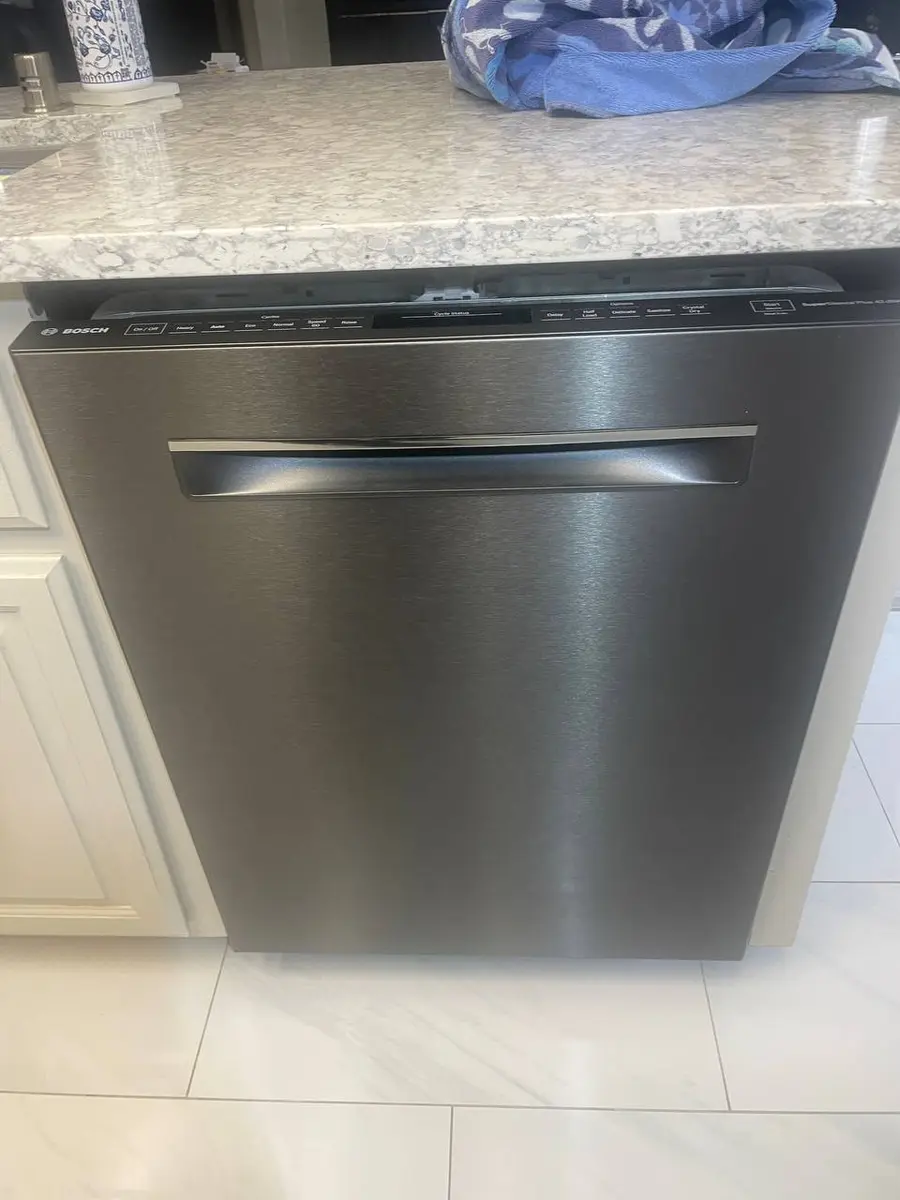
Bosch dishwashers are among the most popular and reliable brands in the United States, known for their quiet operation and German engineering. But when something goes wrong, your Bosch dishwasher communicates the problem through error codes on the display panel. Whether you own a Bosch 300 Series, 500 Series, 800 Series, or a Bosch Benchmark model, this guide decodes every error code and walks you through the fix.
How Bosch Dishwasher Error Codes Display#
Bosch dishwashers display error codes in different ways depending on the model and series:
- Models with LCD display: Error codes show as E followed by a number (E15, E24, etc.)
- Models without display (base models): Error codes are indicated by a pattern of flashing lights on the front panel. The number of flashes corresponds to the error number.
- Newer models with Home Connect: Error codes appear both on the unit and in the Home Connect smartphone app.
Basic reset procedure for all Bosch dishwashers:
- Press and hold the Start button for 3–5 seconds until the Active/Clean light comes on.
- Close the door to initiate a drain cycle.
- When the drain cycle completes (about 1 minute), open the door.
- Turn off the dishwasher and wait 60 seconds before restarting.
If the error persists after reset, follow the specific code troubleshooting below.
Do You Have the Right Tools?
Water pressure gauge ($60), spray arm tester, float switch multimeter ($85), and drain inspection camera. Our technician arrives with $3,000+ in professional tools — your diagnostic is free.
Licensed & Insured · 90-Day Warranty · Same-Day Service
E15 — Water in the Base Pan (Anti-Flood)#
The E15 error is the most common Bosch dishwasher code and arguably the most feared. It means the anti-flood sensor (located in the base pan at the bottom of the unit) has detected water where it shouldn't be.
Common causes:
- Leaking door gasket or door seal
- Cracked or loose hose clamp on the sump, pump, or inlet connections
- Failed aquastop inlet valve
- Cracked spray arm or spray arm seal
- Damaged tub or sump housing
How to fix:
- Turn off the dishwasher, unplug it or switch off its circuit breaker, and shut off the water supply valve under the sink.
- Tilt method (quick fix): Carefully tilt the dishwasher backward approximately 45 degrees (have a helper). This moves water away from the float sensor. Lower it back down gently. The sensor may reset.
- Proper fix: With the dishwasher still unplugged and a helper on hand, pull it out from the cabinet. Remove the bottom panel (usually 2–4 Torx T20 screws). Use towels or a wet/dry vacuum to remove water from the base pan.
- With the base pan dry, inspect all hose connections, the door gasket, spray arm seals, and the sump area for the source of the leak. If you cannot find it, leave the next step to a technician: running a short cycle with the bottom panel removed exposes live wiring to water.
- If the aquastop valve has triggered (a small device on the water inlet hose with a power connector), it may need replacement. Once triggered, many aquastop valves do not reset.
Important: Do not repeatedly reset E15 without finding the leak source. The anti-flood system exists to prevent water damage to your kitchen floor and cabinets.
E24 — Drain Error#
The dishwasher cannot drain water within the expected timeframe. After E15, this is the second most common Bosch error code.
Common causes:
- Clogged drain filter basket (the triple-filter system at the bottom of the tub)
- Blocked drain hose or high-loop issue
- Clogged garbage disposal knockout plug (on new disposals)
- Failed drain pump
- Air gap blockage (if equipped)
How to fix:
- Clean the drain filter: Remove the bottom rack. Turn the cylindrical filter counterclockwise and lift it out. Remove the fine mesh filter beneath it. Wash both under running water with a brush. This should be done monthly as maintenance.
- Check the drain hose: The drain hose must have a high loop (elevated above the drain connection) to prevent backflow. If connected to a garbage disposal, ensure the knockout plug was removed when the disposal was installed — this is an extremely common oversight during kitchen remodels.
- Inspect the drain pump: Unplug the dishwasher or switch off its breaker first, then access the drain pump from underneath after removing the bottom panel. Spin the impeller by hand — it should rotate freely. If it's jammed with glass shards or food debris, clear the obstruction. If the motor doesn't activate, test it for continuity with a multimeter while the dishwasher is still unplugged, and compare the reading with the value on the tech sheet.
- Check the air gap: If your dishwasher drains through an air gap (the chrome cylinder on the countertop near the sink), remove the cap and clean the interior.
Safety First — Know the Risks
Live 120V wiring in a wet environment is one of the most dangerous DIY scenarios. Water + electricity = serious shock risk. Our techs are licensed and insured — let them handle the risk.
Licensed & Insured · 90-Day Warranty · Same-Day Service
E25 — Drain Pump Blockage#
Similar to E24 but specifically indicates the drain pump impeller is obstructed or the pump cover is not properly seated.
How to fix:
- Remove the drain filter assembly and look down into the sump area.
- Unplug the dishwasher or switch off its breaker before you reach into the sump. The drain pump cover is a flat disk with a small handle or tab. Turn it counterclockwise and remove it.
- Check for broken glass, bones, fruit pits, or other debris blocking the impeller.
- Ensure the pump cover seats properly when reinstalled — a loose cover prevents proper suction.
E09 — Heating Element Failure#
The dishwasher's heating element (used for heating wash water and drying) has failed or is not reaching the expected temperature.
Common causes:
- Burned-out heating element
- Failed thermistor (temperature sensor)
- Control board not sending power to the heater
- Hard water scale buildup insulating the heating element
How to fix:
- Unplug the dishwasher or switch off its breaker, then test the heating element for continuity with a multimeter. Access from underneath the dishwasher. An open circuit means the element is burned out.
- Inspect for visible damage or heavy scale buildup.
- Check the thermistor (usually mounted near the element or on the sump) and compare its resistance with the value on the tech sheet.
- Heating element replacement is a professional repair.
The Real Cost of DIY
Average DIY attempt: $150-400 in tools you may use once, plus the risk of further damage. Our diagnostic visit costs $0 — we find the problem and give you an honest quote.
Licensed & Insured · 90-Day Warranty · Same-Day Service
E01 / E02 — Control Board Error#
These codes indicate an issue with the main electronic control module.
Common causes:
- Power surge damage to the control board
- Moisture infiltration into the control board housing
- Failed relay or TRIAC on the board
- Software glitch
How to fix:
- Try a hard reset: Turn off the breaker for 5 minutes, then restore power.
- If E01/E02 persists, the control board likely needs replacement. On Bosch dishwashers, the main board is usually located in the door panel.
- Replacing the control board is a technician job: the new board is installed and programmed by a technician.
E04 — Heater Electronics Fault#
E04 means the dishwasher has detected faulty heater electronics during its self-test.
How to fix:
- Reset the dishwasher as described above.
- If E04 returns, turn off the breaker (or unplug the dishwasher) and have the heater electronics checked by a technician.
Don't Void Your Warranty
Opening your appliance yourself may void the manufacturer warranty. Our repair comes with a 90-day guarantee, and we document everything for warranty compliance.
Licensed & Insured · 90-Day Warranty · Same-Day Service
E12 — Heavy Scale/Calcification#
This code appears on some Bosch models when the unit detects excessive mineral buildup affecting performance.
How to fix:
- Run an empty cycle with a dishwasher descaling product.
- If your area has hard water (above 120 PPM), use the built-in water softener (on European-made models) or add a rinse aid regularly.
- Clean the spray arms — remove them by unscrewing the center nut and flush the nozzles under running water. Use a toothpick to clear clogged holes.
E14 / E16 — Water Inlet Issues#
E14 indicates the flow sensor doesn't detect water during filling. E16 indicates water filling when it shouldn't be (unintentional fill).
E14 fix: The flow sensor (also called the flow meter or turbine sensor) monitors the amount of water entering the dishwasher. Common causes are a clogged or calcified flow sensor, a failed flow sensor, low water pressure, or a partially closed water supply valve.
- Check that the water supply valve is fully open.
- Shut off the water supply and unplug the dishwasher before you disconnect the supply hose, then clean the inlet filter screen (located where the water supply hose connects to the dishwasher).
- With the water still off and the dishwasher unplugged, find the flow sensor on or near the water inlet valve. Disconnect it and clean off any mineral deposits.
- If cleaning does not help, replace the sensor.
E16 fix (more serious): The water inlet valve is stuck open, allowing water to enter continuously.
- Shut off the water supply immediately.
- The inlet valve (aquastop valve) needs replacement. This is not a DIY fix for most homeowners due to the integrated aquastop system.
Is It Worth Your Time?
Dishwasher issues overlap between drain pump, wash motor, inlet valve, and control board. DIY diagnosis averages 3-5 hours. Our technician diagnoses the issue in about 30 minutes — same-day appointments available.
Licensed & Insured · 90-Day Warranty · Same-Day Service
E22 — Drain Filter Clogged#
The sensors detect insufficient water flow through the drain system, typically caused by a dirty filter.
How to fix:
- Clean all three levels of the drain filter (cylindrical mesh filter, flat fine-mesh filter, and the coarse debris collector).
- Run a cleaning cycle.
- If the code persists after thorough cleaning, the drain pump may be losing efficiency (see E24).
E27 — Low Voltage#
The dishwasher detects power supply voltage below the operating threshold.
How to fix:
- Check your home's voltage with a multimeter at the outlet. Bosch dishwashers require 120V ±10% (108V–132V).
- Avoid running the dishwasher during peak electrical usage times if you have voltage drop issues.
- If voltage is consistently low, consult an electrician — the issue is in your home's electrical system, not the dishwasher.
The Risk of Getting It Wrong
A wrong diagnosis often turns a simple fix into a costly replacement. Without proper diagnostic tools, you might replace the wrong part — or cause additional damage. Our free diagnostic eliminates the guesswork.
Licensed & Insured · 90-Day Warranty · Same-Day Service
Bosch Dishwasher Diagnostic Mode#
For newer Bosch models (2015+):
- Close the door.
- Press and hold the two buttons to the left and right of the Start button simultaneously for 3 seconds.
- The display enters diagnostic mode showing the last recorded error.
- Press the Start button to advance through the diagnostic tests.
For older models:
- Turn the program dial to the OFF position.
- Press and hold the Power Scrub Plus + Regular Wash buttons (or the two rightmost program buttons).
- While holding, turn the dial to position 1. Release buttons after 3 seconds.
- The diagnostic test begins automatically.
Preventive Maintenance Schedule#
Preventing error codes is easier and cheaper than fixing them:
- Monthly: Clean the triple-filter system. Run an empty hot cycle with a cup of white vinegar.
- Every 3 months: Clean spray arm nozzles. Wipe door gasket with a damp cloth. Check and clean the drain area.
- Every 6 months: Inspect the door gasket for wear or damage. Run a descaling cycle if you have hard water. Check the drain hose for kinks.
- Annually: Unplug the dishwasher and, with a helper, pull it out to inspect the base pan for moisture. Check all hose connections for leaks. Inspect the aquastop valve and water supply line.
Free Diagnostic Visit — Zero Risk
Our certified technician comes to your home, diagnoses the problem with professional tools, and gives you an honest quote — all at zero cost. No parts markup, no hidden fees. If you decide not to proceed, you pay nothing.
Licensed & Insured · 90-Day Warranty · Same-Day Service
Frequently Asked Questions#
Q: How do I clear the E15 error on my Bosch dishwasher? A: The quickest method is to unplug the dishwasher and, with a helper, tilt it backward about 45 degrees to move water off the float sensor, then lower it back. However, this only resets the sensor — you must find and fix the leak that caused E15 in the first place. With the dishwasher still unplugged and its water supply shut off, pull the unit out with a helper, remove the bottom panel, dry the base pan, and inspect all connections; a test cycle with the panel off to pinpoint the leak is a job for a technician.
Q: Why does my Bosch dishwasher show E24 when the filter is clean? A: If E24 persists after cleaning the filters, check these often-overlooked causes: (1) the garbage disposal knockout plug wasn't removed, (2) the drain hose doesn't have a proper high loop, (3) the check valve in the drain pump is stuck, or (4) the drain pump impeller is worn and can't generate enough suction. Try disconnecting the drain hose at the disposal/sink connection and running a drain cycle into a bucket to isolate the problem.
Q: What is the lifespan of a Bosch dishwasher? A: How long a Bosch dishwasher lasts depends on how it is used and maintained. The 800 and Benchmark series tend to last slightly longer due to higher-quality components. The most common end-of-life failure is the circulation pump motor.
Q: Is it worth repairing a Bosch dishwasher? A: Generally yes for units under 8 years old. Bosch uses high-quality components that justify repair costs. Common repairs like the drain pump, door gasket, or inlet valve are usually worth it on a dishwasher of this quality. For units over 10 years old with major component failures (circulation pump, control board), replacement may be more cost-effective.
When to Call a Professional#
Certain Bosch dishwasher repairs should be left to certified technicians:
- E15 with recurring leaks — If you've cleared E15 multiple times and the leak persists, a technician can pressure-test connections and identify hidden leaks.
- E01/E02 control board errors — Board-level diagnosis requires specialized equipment, and replacement boards must be programmed to your specific model.
- E16 (unintended water fill) — A stuck-open inlet valve is a flood risk and should be addressed urgently by a professional.
- Any error involving the circulation pump — The main wash pump is integrated into the sump assembly and requires significant disassembly to access.
- Aquastop valve replacement — Bosch's integrated aquastop system requires precise installation to function correctly as a safety device.
Bosch-trained technicians have access to proprietary diagnostic software and can read detailed error logs stored in the control board's memory, often revealing intermittent issues that a single error code doesn't capture.
Dealing with a stubborn Bosch dishwasher error code? EasyBear's technicians are experienced with all Bosch series and carry the most common Bosch parts on every service call. We offer a free diagnostic visit — our tech will identify the exact problem, explain the repair options and costs upfront, and fix it on the spot in most cases. Every repair includes our 90-day parts and labor warranty. Book your free Bosch dishwasher diagnosis today.